
A No Smoking Sign is a clear visual notice that identifies an area where smoking is not permitted. It helps visitors, staff, and contractors understand a site’s expectations without needing a verbal reminder. Most signs use familiar wording, a crossed-out cigarette symbol, or both. Strong contrast and readable lettering make the message easier to notice near entrances, shared rooms, and other decision points. Keep it simple.
The sign’s value depends on more than its wording. Placement matters: a notice hidden behind a door or crowded by posters may go unseen. Durable materials can help signs remain legible outdoors, where sunlight and rain gradually fade colors. Organizations should also check signs periodically and replace damaged or outdated ones. Small details count.
A No Smoking Sign communicates a practical boundary, but it cannot explain every site-specific rule by itself. Requirements and recommended wording may differ by location and setting, so organizations should confirm applicable guidance with qualified local sources. Clear symbols can support people who read different languages, though symbols should not be treated as a complete substitute for accessible text. There is room to improve. A sign may look clear to its designer yet confuse someone approaching from another direction. Reviewing it from a visitor’s point of view can reveal that gap. This guide explores what these signs mean, where they are commonly used, and what makes them easier to understand and maintain.
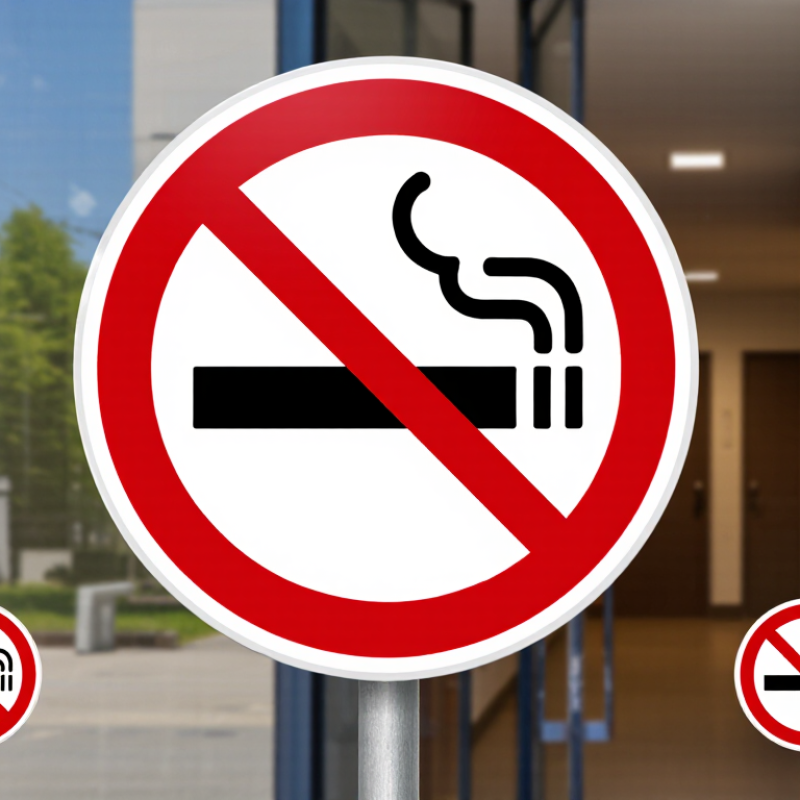
A no smoking sign is a visual notice that marks an area where smoking is not permitted. Its purpose is simple: communicate the restriction quickly, even to someone passing by. Most signs use direct wording, a familiar crossed-out cigarette symbol, or both. The message should be readable at a glance. Short text helps. Strong contrast, such as dark lettering on a light background, makes the notice easier to spot near a doorway, reception desk, or shared hallway.
The core features are clarity, visibility, and suitability for the setting. A small sign may work beside a desk, while a larger one may be easier to see across a busy entrance.
Place it near the point where people make a choice, rather than behind a door or among crowded notices. Choose material that suits the location; a sign exposed to rain or frequent cleaning needs a surface that holds up. No design is perfect. A symbol can be misread, and a sign hidden by a plant helps no one. Check its condition and sightline now and then, and adjust the placement if visitors still miss it.
What Is a No Smoking Sign?
A no smoking sign combines a familiar symbol with direct wording. The common symbol shows a cigarette inside a red circle with a diagonal slash. Its meaning is immediate, even when viewers speak different languages. Standardized safety systems, including ISO 7010, use this visual approach to reduce uncertainty. The wording usually says “No Smoking,” “Smoking Prohibited,” or “Smoke-Free Area.” “No Smoking” is short and widely understood. “Smoking Prohibited” sounds more formal, but may feel less conversational. Small differences matter.
Design elements affect how quickly people notice the message. Strong contrast, large lettering, and a clean background improve readability. A sign placed near an entrance should be visible before someone enters, not behind a door. Add a cigarette symbol beside the words, rather than relying on text alone.
The World Health Organization reports that tobacco use causes more than 8 million deaths each year, including about 1.3 million non-smokers exposed to secondhand smoke. Fire prevention also matters. The National Fire Protection Association reported 15,897 home structure fires caused by smoking materials in the United States from 2017 to 2021. Those figures support clear, visible communication.
Still, perfect design is not guaranteed. A crowded sign can weaken the message. Tiny text fails in low light. A useful detail may be overlooked: placement often matters as much as appearance.
A no smoking sign explains that smoking is not permitted in a specific area. Its value depends heavily on where people can see it. A well-placed sign answers a practical question before anyone lights a cigarette.
These signs are commonly displayed near main entrances, reception desks, and exit doors. Visitors often pause in these areas, making them useful points for clear instructions. Outdoor signs may appear beside walkways, parking areas, waiting zones, and building boundaries. They should face approaching people, not point toward a wall or crowded noticeboard.
Inside, signs are often placed in hallways, elevators, stairwells, restrooms, kitchens, and shared lounges. Workplaces may also display them near meeting rooms and storage areas. Schools, clinics, hotels, and public buildings usually need signs where visitors, staff, and contractors naturally gather. No smoking.
A sign near an entrance should sit at eye level and remain visible in poor weather or low light. Durable materials help, especially beside outdoor doors. Clear wording and a recognizable symbol can support people who speak different languages. Vaping rules may need separate wording, because a basic smoking symbol may not explain every restriction.
I have seen signs hidden behind open doors or covered by temporary notices. That weakens their purpose. Placement should also avoid blocking emergency instructions, accessibility features, or exit hardware. Local building policies may influence the final position. Even careful layouts can miss a busy corner, so checking the site from a visitor’s viewpoint is worthwhile.
Common placement points selected for visibility, access control, and smoke-free area identification.
No smoking signs are commonly placed at entrances, in enclosed workplaces and public buildings, near elevators and stairwells, inside public vehicles, and at the boundaries of smoke-free areas. These locations help communicate restrictions before people enter or use the space.
A no smoking sign is a clear visual notice that smoking is not permitted in a specific area. It usually combines simple wording with a crossed-out cigarette symbol. People can understand it quickly, even in busy places. The sign may appear near entrances, elevators, waiting areas, children’s facilities, or shared indoor spaces. Its purpose is practical: reduce confusion before smoke affects others.
No smoking signs support safety by marking cleaner air zones and lowering exposure to secondhand smoke. They can also reduce fire risks near paper, fabric, fuel storage, and other flammable materials. Effective signs should be easy to see, well lit, and placed at eye level. They work best near doors and transition points, where people make decisions. Clear placement matters.
Public health depends on more than one notice. Good ventilation, staff training, and consistent communication also help protect visitors and workers. In my experience, a faded sign or crowded wall can weaken an otherwise sensible safety plan. That detail is easy to overlook. Some signs are technically present but practically invisible. Facilities should review their placement regularly and replace damaged materials. Local requirements may differ, so responsible managers should check current guidance and adapt their signs accordingly. A sign cannot control every behavior, but it can establish a visible expectation and support a safer shared environment.
| Data Dimension | Key Information | Safety and Public Health Value |
|---|---|---|
| Definition | A no smoking sign is a visual notice that prohibits smoking in a stated area or advises people that smoking is not permitted. | It communicates a clear rule quickly and supports consistent smoke-free behavior. |
| Common Message | Typical wording includes “No Smoking,” often combined with a crossed-out cigarette symbol. | Short text and a familiar symbol improve recognition for people with different language backgrounds. |
| Primary Purpose | To identify smoke-free areas and discourage smoking, including the use of combustible tobacco products where applicable. | The sign helps reduce exposure to tobacco smoke and supports the enforcement of smoke-free policies. |
| Typical Locations | Common locations include indoor workplaces, schools, hospitals, public transportation areas, restaurants, entrances, and shared outdoor spaces. | Visible notices help protect people in places where smoke can affect occupants, visitors, or passersby. |
| Secondhand Smoke Reduction | Smoke-free rules supported by signage help limit involuntary exposure to secondhand tobacco smoke. | Secondhand smoke contains harmful substances and can contribute to respiratory and cardiovascular health risks. |
| Fire Prevention | The sign discourages smoking near flammable materials, oxygen equipment, fuel storage, dry vegetation, and other fire-sensitive areas. | Reducing ignition sources can lower the risk of fires, burns, property damage, and emergency evacuations. |
| Visual Design | Effective signs generally use high contrast, simple wording, a recognizable prohibition symbol, and a clear layout. | Good visual design improves noticeability and reduces confusion in busy or crowded environments. |
| Placement | Signs are most useful at entrances, exits, decision points, designated boundaries, and areas where smoking may create a hazard. | Strategic placement gives people notice before they enter or use a smoke-free area. |
| Accessibility | Signs should be easy to see, adequately lit, unobstructed, and understandable to the intended audience. | Accessible communication helps more people understand the rule, including visitors and people with limited language proficiency. |
| Policy Support | A sign reinforces an organization's or property's smoke-free policy but does not replace applicable laws, procedures, or staff communication. | Consistent signage makes expectations clear and can support fair, predictable policy enforcement. |
| Maintenance | Signs should be kept clean, readable, securely mounted, and replaced when damaged, faded, or covered. | Well-maintained signs remain visible and preserve the credibility of the smoke-free message. |
Rules and standards governing no smoking signs vary by country, region, and building type. Local public health, workplace safety, fire, and property regulations may define where signs are required. Rules differ by location. A sign near a main entrance may need to be visible from the pavement, not hidden behind a door or plant. Many authorities expect clear wording, a recognizable symbol, strong contrast, and enough size for easy reading. The exact requirements should be checked with the relevant local authority.
Placement matters as much as design. Signs are commonly installed at entrances, reception areas, elevators, stairways, shared rooms, and outdoor gathering points. They should remain visible under normal lighting and withstand rain when placed outside. A simple red circle and crossed cigarette symbol can communicate quickly, but supporting words may help visitors who do not recognize the symbol. Use readable lettering and avoid crowded layouts. Accessibility also deserves attention, including suitable height, contrast, and visibility for people approaching from different directions.
In practical inspections, poorly maintained signs often cause confusion. Faded ink, peeling edges, or blocked sightlines weaken the message. A sign may satisfy a checklist yet fail in real use. That deserves honest review. Building managers should record installation dates, inspect signs periodically, and replace damaged materials. They should also confirm whether the rule covers only indoor areas or nearby outdoor spaces. Local guidance remains decisive, because a familiar design is not automatically a legally sufficient one.
It often shows a cigarette inside a red circle with a diagonal line. The symbol is easy to recognize.
Signs may say “No Smoking,” “Smoking Prohibited,” or “Smoke-Free Area.” Short wording is often easier to read.
Place it near entrances, reception areas, elevators, stairways, and shared rooms. People should see it before entering.
Use strong contrast, large lettering, and a clean background. Tiny text can disappear in dim light.
Yes. Requirements may vary by region, building type, and applicable local rules. Check with the relevant local authority.
Not always. Supporting words can help visitors who do not recognize the symbol.
Check for fading, peeling edges, and blocked views. Outdoor signs should withstand rain and remain readable.
Inspect them periodically and record installation dates. A checklist helps, but it cannot catch every real-world visibility problem.
A No Smoking Sign is a clear visual notice that informs people smoking is not permitted in a particular area. It commonly combines a recognizable cigarette symbol, a circle, and a diagonal line, often supported by simple wording such as “No Smoking” or “Smoking Prohibited.” Effective designs use strong contrast, readable lettering, and durable materials so the message remains visible in different lighting and weather conditions. Some signs may also include symbols for vaping or other related activities when a location’s policy requires broader coverage.
These signs are typically displayed at entrances, near doors, in public buildings, workplaces, transportation areas, healthcare facilities, schools, and other shared spaces. By providing an immediate and consistent reminder, they help reduce exposure to smoke, protect indoor air quality, and support a cleaner, healthier environment. Their placement, size, wording, and accessibility are often guided by local rules, building policies, safety procedures, and recognized sign standards. Properly maintained signage helps organizations communicate expectations clearly and encourage respectful behavior.
